
Quick Summary
A supplement in auto body repair is an update to the original repair estimate. It is used when a shop finds additional damage, labor, parts, refinish work, diagnostic needs, or repair procedures during a closer inspection.
For Los Angeles drivers, this often becomes important after a collision when a closer inspection adds to the visible story. A bumper cover, door panel, quarter panel, light assembly, or trim piece can cover damage underneath. Once the vehicle is inspected more closely or disassembled, the repair plan may need to be updated.
A supplement gives a responsible repair facility a clear way to document what the vehicle actually needs.
For more than 41 years, Network Auto Body has built its local reputation on helping drivers understand the repair process clearly. A supplement is part of that transparency: it turns hidden damage into documented repair information so the customer, shop, and insurer can see what changed and why.
What Is a Supplement in Auto Body Repair?
A supplement in auto body repair is a written update to the original repair estimate. It adds or revises repair items after the shop finds more information about the vehicle’s damage.
The first estimate is usually based on what can be seen during the initial inspection. That may include visible dents, scratches, cracked bumper covers, broken lamps, damaged panels, and obvious paint damage. Collision damage is often layered, with some parts positioned behind exterior panels, bumper covers, interior trim, or structural components.
A supplement is used to bring the original estimate in line with the final repair scope.
| In plain language, a supplement says: “After inspecting the vehicle more closely, we found additional repair needs that should be added to the repair plan.” |
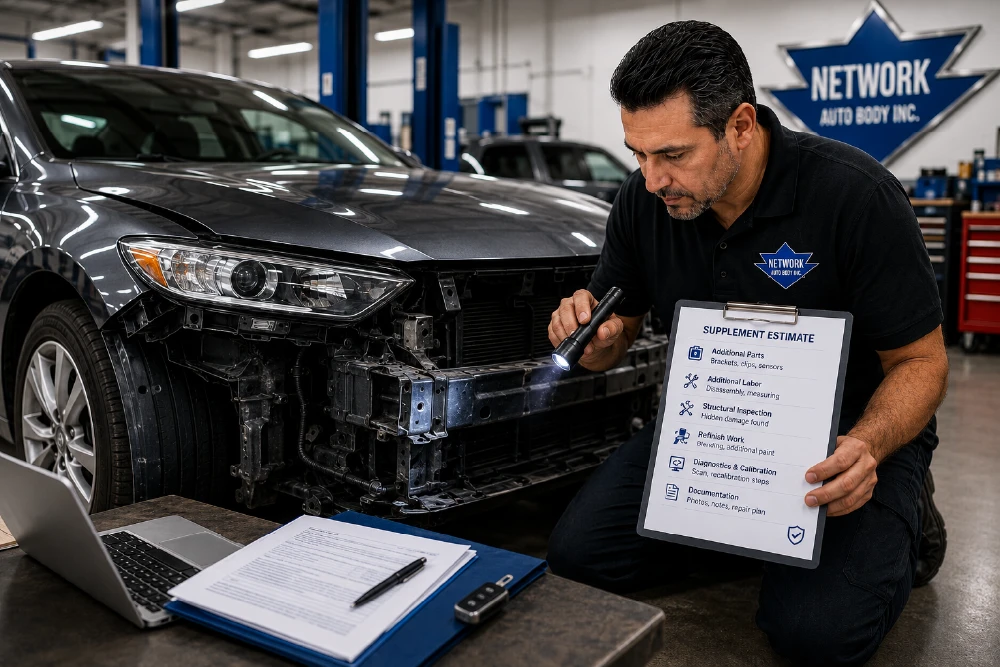
That update may involve parts, labor, paint materials, diagnostic scans, calibration steps, structural inspection, or documentation needed for insurance review.
A supplement can be small or significant. Sometimes it is as simple as a broken bracket or damaged clip. Other times, it may involve hidden structural damage, damaged sensors, a revised parts plan, or additional refinish work.
The key point is that a supplement should be documented clearly. Customers should be able to understand what was found, why closer inspection was needed, and how it affects the repair plan.
A Supplement Builds on the Original Estimate
A supplement adds to the original estimate and builds on it.
The original estimate starts the repair conversation. The supplement updates it after new damage or repair requirements are discovered. Together, they create a more complete repair record.
| Item | What It Means |
| Original estimate | The first repair plan based on visible or initially confirmed damage |
| Supplement | An update that adds newly discovered or newly confirmed repair needs |
| Final repair record | The completed, approved repair plan after documented changes |
Why Supplements Happen After the First Estimate
Supplements happen because a closer inspection can reveal additional accident damage.
A vehicle may look damaged in one obvious area, while the impact can also affect parts behind the visible surface. For example, a rear bumper cover may look scraped or cracked, while the reinforcement bar, absorber, brackets, sensors, or rear body panel behind it may also be damaged. A front-end impact may damage headlight mounts, radiator support areas, wiring, splash shields, or structural attachment points that become clearer during a closer inspection.
This is why the supplement process exists.
The supplement gives the customer a clear record of the difference between what was visible at first and what the shop found after closer inspection.
Network Auto Body’s Estimate Process page explains that visible damage is entered first, and the shop continues by looking for hidden collision damage revealed once the vehicle is disassembled and the structure is exposed.
Common Reasons a Supplement May Be Needed
- Hidden damage behind a bumper, panel, lamp, or trim piece
- Broken brackets, tabs, clips, or mounting points
- Additional parts that must be repaired or replaced
- Structural or unibody damage that needs further inspection
- Paint blending or refinish work confirmed during closer inspection
- Diagnostic scan needs or calibration-related steps
- Wiring, sensor, camera, or radar concerns
- Updated manufacturer procedures or repair documentation
- Parts changes based on repair method, availability, or claim review
In modern collision repair, this matters because vehicles include much more than panels and paint. They include sensors, advanced materials, electronics, restraint systems, cameras, and manufacturer-specific repair procedures. A supplement helps the repair team document those needs and complete each required step.
For Los Angeles drivers or customers visiting the nearest Network Auto Body location in Valencia, Downtown L.A., North Hollywood, Van Nuys, or Oxnard, an updated estimate provides useful information. It helps create a repair plan that covers both the visible damage and the areas revealed during closer inspection.
| Key Takeaway: A good supplement brings the repair closer to the real condition of the vehicle. |
What Can Be Included in an Auto Body Repair Supplement?
An auto body repair supplement can include any additional repair item that is found, confirmed, or required after the original estimate was written.
The exact content depends on the vehicle, the damage, the insurance claim, and the repair plan. Most supplements fall into a few common categories.
| Supplement Category | What It May Include | Why It Matters |
| Parts | Additional replacement parts, brackets, clips, retainers, lamps, sensors, covers, reinforcement parts | Helps restore fit, function, and repair completeness |
| Labor | Extra repair time, disassembly, reassembly, measuring, structural labor, mechanical labor | Reflects the work needed beyond the first visible estimate |
| Paint and refinish | Additional refinish labor, blending, materials, prep time, clear coat work | Helps achieve a more complete and consistent finish |
| Diagnostics | Pre-repair scans, post-repair scans, sensor checks, calibration-related steps when applicable | Supports modern vehicle safety and electronic systems |
| Structural inspection | Measuring, frame or unibody review, hidden reinforcement damage | Helps identify deeper collision damage |
| Documentation | Photos, notes, repair procedure references, revised line items | Gives the customer and insurer a clearer repair record |
| Warranty-related repair clarity | Workmanship-related documentation for qualifying repairs | Helps protect the integrity of a repair backed by Network Auto Body’s Lifetime Warranty |
A supplement should be specific and make the repair plan easier to understand.
For example, “replace damaged left bumper bracket discovered after bumper cover removal” provides more detail than “additional bumper repair.” The specific explanation tells the customer what was found and why it was added.
Supplements and Manufacturer-Aligned Repair Planning
Supplements are especially important when the repair involves newer vehicles, sensors, advanced driver assistance systems, or manufacturer-specific repair procedures.
Network Auto Body’s model is dealer-driven and manufacturer-aligned, based on the onboarding sheet. That matters because modern vehicles often require more than visual repair. A bumper, grille, mirror, or rear body area may involve sensors, radar units, cameras, wiring, or mounting points that must be handled carefully.
A supplement gives the repair team a place to document those findings and connect the added repair steps to the vehicle’s actual needs.
This is also where Network Auto Body’s Lifetime Warranty positioning matters. A meticulous supplement process helps ensure deeper repair work is documented clearly, especially for qualifying workmanship-related body, unibody, and refinish repairs covered under the company’s warranty terms. Network Auto Body’s live warranty page states that its Lifetime Warranty covers workmanship-related unibody, body, and finish work for as long as the customer owns the vehicle, subject to stated limits and exclusions.
A supplement is more than an estimated update. Done correctly, it is part of building a repair record that is clearer, safer, and more accountable.
How the Auto Body Repair Supplement Process Usually Works
The supplement process is the way a body shop documents repair needs confirmed after the original estimate.
The exact workflow can vary depending on the shop, the insurance company, the vehicle, and the type of damage. Still, most auto body repair supplements follow the same basic path: inspect, document, submit, review, update the repair plan, and continue the repair.
Step 1: The Original Estimate Is Written
The process begins with the first repair estimate. This may come from a body shop, an insurance adjuster, an online estimate, or an initial inspection.
At this stage, the estimate usually focuses on visible or initially confirmed damage. The estimator may note damaged panels, cracked bumpers, broken lights, obvious paint damage, and basic labor or parts needs.
This estimate is important and serves as the first stage of the complete repair plan.
A closer inspection can show what is behind the damaged parts and add everything needed for newer vehicles with sensors, cameras, radar components, advanced materials, or manufacturer-specific repair procedures.
Step 2: The Vehicle Is Inspected More Closely
Once the vehicle is at the repair facility, the shop may inspect the damage more closely. This may include additional visual inspection, measuring, documentation, or partial disassembly.
If the damage is simple and fully visible, the original estimate may stay mostly the same. If the inspection reveals hidden damage, the repair plan may need to be revised.
For example, a bumper cover may be removed and the technician may find damaged reinforcement, broken brackets, wiring concerns, or sensor-related issues. A door panel may come apart and reveal damage to inner components. A rear-end collision may show additional damage behind the trunk trim or rear body area.
This is where the supplement process becomes useful.
Step 3: Additional Damage Is Documented
A supplement should be supported by clear documentation.
The shop may take photos, write notes, update line items, and identify the added parts, labor, refinish work, or diagnostic steps that are now needed. If the supplement involves manufacturer procedures, sensors, structural repair, or warranty-related workmanship, the documentation becomes even more important.
For Network Auto Body customers in Los Angeles, this documentation step is especially important because it supports transparency. A customer should be able to see what was found and understand why it matters.
A supplement should help answer:
- What additional damage was found?
- Where was it located?
- What made it clearer during the closer inspection?
- What repair work is now needed?
- Does it affect parts, labor, paint, diagnostics, calibration, or structure?
- Does it affect timing or next steps?
Step 4: The Supplement Is Submitted for Review
If insurance is involved, the body shop may submit the supplement to the insurance company or adjuster for review. This review may include photos, updated estimate line items, parts information, repair notes, and any relevant documentation.
This is where clear expectations help.
A submitted supplement moves through the insurer’s approval process, which considers the claim details, policy terms, documentation quality, and the nature of the damage.
A transparent repair facility should explain where the supplement stands in the process and whether the repair is waiting on review, approval, parts, or another step.
Step 5: The Repair Plan Is Updated
Once the supplement is reviewed, the repair plan can be updated. The updated plan may include added parts, adjusted labor, extra paint work, structural inspection, scans, calibration steps, or other repair operations.
This is the point where the estimate becomes more accurate because it reflects more than the first visible inspection.
The supplement helps ensure the repair plan reflects the vehicle’s actual damage.
Step 6: Repairs Continue With a Clearer Scope
After the supplement is documented and handled through the appropriate review process, the repair can continue based on the updated scope.
This review may add time to the process, and it often supports a stronger result later. Addressing hidden damage through the supplement helps achieve proper fit, complete structural and electronic repairs, accurate paint matching, and clear documentation.
A strong supplement process protects the customer, the repair record, and the quality of the finished repair.
Supplement vs. Original Estimate: What Changes?
Many customers naturally expect the first estimate to be the final number. Understanding that the first estimate and the supplement have different roles makes the collision repair process clearer.
The original estimate starts the process. The supplement updates the process.
| Comparison Point | Original Estimate | Supplement |
| Timing | Written at the beginning of the repair process | Created after additional damage or repair needs are found |
| Basis | Visible or initially confirmed damage | Newly discovered or newly confirmed damage |
| Purpose | Starts the repair plan and claim discussion | Updates the repair plan with more accurate information |
| Common source | First inspection, photos, adjuster review, or shop estimate | Teardown, deeper inspection, documentation, repair procedure review |
| What it may include | Basic parts, labor, refinish, and visible damage items | Added parts, labor, paint, diagnostics, calibration, structural or documentation items |
| Customer concern | Is this enough to fix the vehicle? | Why did the estimate change? |
| Best response | Review what is included and what may require further inspection | Ask for documentation, photos, explanation, and next steps |
A supplement may change the cost, the timeline, or the repair steps. The repair scope is often the most important change.
A supplement helps the repair plan become more specific.
For example, an original estimate may say a bumper cover needs repair or replacement. After disassembly, the supplement may add a damaged reinforcement bracket, absorber, wiring repair, sensor inspection, or refinish adjustment. That added detail explains why the repair is more involved than the first estimate suggested.
A Supplement Should Make the Repair Clearer
The best supplements are easy to understand and give the customer clear information.
A clear supplement should explain:
- What changed from the original estimate
- What damage was discovered
- What labor or parts were added
- Whether insurance review is needed
- Whether the repair timeline may change
- Whether the new item affects safety, fit, electronics, structure, or finish
At Network Auto Body, this kind of documentation connects directly to the company’s 41-year history serving Los Angeles-area drivers. For customers visiting the nearest Network Auto Body location in Valencia, Downtown L.A., North Hollywood, Van Nuys, or Oxnard, the goal includes repairing visible damage and explaining the repair plan clearly enough that customers understand what is happening to their vehicle and why.
That transparency matters because a supplement often appears while the customer is managing insurance, transportation, cost, and timing. A clear explanation helps turn those concerns into a practical next step.
Does Insurance Cover Auto Body Repair Supplements?
Insurance coverage for an auto body repair supplement depends on the claim, the policy, the damage, and the insurer’s review.
This is one of the most important points for customers to understand.
A body shop can document additional damage and submit a supplement. The insurance company then reviews the information. The supplement may need photos, line-item detail, repair notes, parts information, and sometimes additional explanation.
Customers can view a supplement as a documented request or update that moves through the claim review process. Approval depends on the insurer’s review and the supporting information.
Why an Insurance Supplement May Be Needed
An insurance estimate is often written early in the process. Sometimes it is based on visible damage, photos, or a short inspection. Disassembly can then reveal additional damage.
Once the body shop begins repair planning or disassembly, the shop may find damage to add to the original insurance estimate.
Examples include:
- Hidden bumper reinforcement damage
- Broken mounting brackets
- Damaged lamps or lamp mounting tabs
- Wiring or sensor issues
- Additional refinish or paint blending needs
- Structural or unibody damage
- Parts differences based on the approved repair method
- Diagnostic or calibration-related needs
When that happens, the supplement helps document the added repair needs for insurer review.
What Customers Should Expect During Insurance Review
If insurance is involved, the review process may affect timing. The shop may need to wait for review, approval, additional photos, adjuster communication, or parts authorization before continuing certain work.
The repair process may continue with other approved work, or certain steps may pause until the added items are reviewed.
The best approach is to ask the shop for a clear status update:
- Has the supplement been submitted?
- What items were added?
- Is anything waiting on the insurance review?
- Are parts already ordered?
- Does this affect the estimated completion timeline?
- What can continue while the supplement is being reviewed?
A Supplement Protects the Repair Record
A supplement covers payment and documentation.
When hidden damage is discovered and documented, the final repair record can reflect the full scope of the work the vehicle needed. This provides clarity if the customer has questions about parts, workmanship, paint, structure, or warranty-related items.
This is why a careful supplement process matters. It supports the customer, the repair facility, the insurance review, and the long-term clarity of the repair record.
Network Auto Body’s Lifetime Warranty makes this documentation especially important for qualifying workmanship-related repairs. When a supplement clearly records hidden damage, repair decisions, and approved work, it helps protect the integrity of the finished repair and the warranty-backed workmanship behind it.
Hidden Damage Examples That Often Lead to Supplements
Supplements are common because many collision repairs involve damage confirmed during a closer inspection. Some damage is visible right away. Other damage is hidden behind panels, covers, trim, lights, or structural parts.
That is why a supplement is often connected to teardown or deeper inspection. The shop needs to see what is behind the first layer of damage before the full repair scope can be documented.
Here are common examples of hidden damage that may lead to an auto body repair supplement.
Bumper Reinforcement Damage
A bumper cover is the outer painted part most drivers notice first. Behind that cover, there may be absorber foam, reinforcement bars, brackets, mounting points, sensors, wiring, and structural attachment areas.
After a rear-end or front-end collision, the bumper cover may initially look scratched, cracked, or slightly pushed in. Once removed, the shop may find that the reinforcement behind it is bent, cracked, or misaligned.
If that happens, the supplement may add parts, labor, structural inspection, or related operations discovered after the first estimate.
Broken Brackets, Clips, and Mounting Tabs
Small parts can have a big effect on repair quality.
Brackets, clips, retainers, tabs, and fasteners help hold bumpers, lamps, trim, wheel liners, splash shields, and panels in the correct position. Replacing damaged pieces helps the vehicle fit together correctly after repair.
For example, the supplement can address a bumper that sits unevenly, a headlight that needs alignment, a loose fender liner, or an uneven panel gap.
These items often become visible during a closer inspection, especially when they are behind the damaged exterior part. Once the shop confirms the damage, those items may be added through a supplement.
Lighting and Lamp-Area Damage
Headlights and taillights are more complex than they may look. An intact lamp lens can still have damaged mounting tabs or surrounding support areas.
A supplement may include lamp replacement, lamp mounting repair, bracket replacement, or additional labor to correct the surrounding fit.
This is especially important because lighting components affect more than appearance. They can also affect visibility, alignment, sealing, and vehicle fitment.
Sensor, Radar, Camera, or Wiring Concerns
Modern vehicles often place sensors, cameras, radar units, and wiring near bumpers, grilles, mirrors, and body panels. A collision can affect these components even when the outside damage appears minor.
A supplement may be needed if the shop finds:
- Damaged parking sensors
- Broken sensor brackets
- Camera mounting issues
- Radar-area damage
- Wiring harness damage
- Connector damage
- Diagnostic scan needs
- Calibration-related steps, when applicable
Because modern vehicle systems require precise placement, Network Auto Body’s dealer-driven and manufacturer-aligned approach matters here. The repair team can document hidden sensor, radar, wiring, or structural concerns and connect the repair plan to the vehicle’s actual requirements through a complete review that goes beyond surface-level damage.
Each collision has different repair needs, and modern collision repair verifies paint, panels, and any related calibration or diagnostic requirements.
Structural or Unibody Concerns
Structural repair needs vary by accident, and some impacts can affect deeper areas such as reinforcement points, inner panels, radiator support areas, rear body panels, trunk floors, quarter structures, or unibody attachment points.
If the shop identifies deeper collision damage, the supplement may include measuring, structural labor, replacement parts, repair procedures, or additional inspection.
This type of supplement is especially important to document clearly for the customer. Structural and unibody-related repairs benefit from specific, well-supported line items.
Paint, Refinish, and Blending Changes
A supplement can also include paint and refinishing updates.
Sometimes the first estimate focuses on obvious paint damage. After disassembly or repair planning, the shop may confirm that a replacement panel needs refinishing, an adjacent panel needs blending, or additional preparation is needed to complete the repair properly.
This can happen with metallic, pearl, tri-coat, or aged finishes where color transition matters. It can also happen when the repair method changes from repairing a part to replacing it.
Part Type or Parts Availability Changes
Supplements may also happen when the parts plan changes.
For example, the shop may need to add a part discovered after the first estimate, revise a part type, or account for availability. Depending on the repair plan and claim review, the estimate may reference OEM, aftermarket, recycled, reconditioned, or other replacement-part categories.
This is where clear documentation matters. Customers should be able to see what part was added or changed, why it matters, and how it fits into the repair plan.
What Customers Should Ask When a Supplement Is Submitted
A supplement means the repair plan has changed, and a clear explanation can help the customer move forward with confidence.
A good repair facility should be able to explain the supplement in plain language. Customers can focus on understanding what changed, why it changed, and what happens next while the repair team handles the estimating codes and procedures.
“What Damage Was Found After the First Estimate?”
Start with the simplest question. Ask the shop to identify the new damage clearly.
A helpful answer may sound like:
- The bumper reinforcement was damaged behind the cover.
- The left headlamp mounting tabs were broken.
- The rear body panel has damage that was hidden behind trim.
- The wiring connector in the impact area needs attention.
- Additional blending is needed because the repair area changed.
The answer should be specific enough to make sense.
“Why Did This Item Require a Closer Inspection?”
This helps clarify whether the item was hidden, newly discovered, newly confirmed, or added because of the repair method.
Sometimes the answer is simple: the damaged part was behind another part. Other times, the item may require disassembly, measuring, scan results, or repair procedure review before it can be confirmed.
The goal is to understand the repair timeline.
“Can I See Photos or Documentation?”
Photos are helpful because they make hidden damage visible to the customer. Documentation can also help the insurer review the supplement.
A clear supplement should be supported by photos, notes, line items, or other repair documentation where appropriate.
“Has the Supplement Been Sent to Insurance?”
If insurance is involved, ask whether the supplement has already been submitted. If it has, ask whether the shop is waiting for review or whether the repair can continue.
This is especially useful if you are trying to understand timing.
“Will This Affect the Repair Timeline?”
A supplement may affect timing if parts need to be ordered, insurer review is pending, or the repair method changes. Asking this question gives the customer a clearer view of the schedule.
A transparent shop should be able to explain whether the supplement affects the estimated completion window.
“Does This Affect the Warranty-Backed Repair Work?”
If the added work involves body, unibody, or refinish workmanship, ask how it will be documented in the repair record. For Network Auto Body customers, this is especially relevant because qualifying repairs are backed by the company’s Lifetime Warranty terms.
The goal is to make sure the repair record is clear from the beginning.
Questions and Facts: Supplements Support a Complete Repair Plan
Because supplements often involve estimate changes, customers may have questions about what changed. That reaction is understandable, and a clear explanation can provide reassurance after an accident.
In many cases, a supplement is a normal and necessary part of documenting the complete repair scope.
| Common Question | Helpful Explanation |
| What does a supplement say about the first estimate? | The first estimate may accurately reflect visible damage, while a supplement documents hidden damage found later. |
| How should added repair work be supported? | A proper supplement should be supported by photos, notes, line items, or repair documentation. Ask for a clear explanation. |
| How does insurance review a supplement? | The insurer reviews the supplement based on claim details, policy terms, and documentation. |
| Can a minor-looking accident lead to a supplement? | Sometimes minor-looking damage hides broken brackets, reinforcement damage, wiring issues, or sensor concerns. |
| How do the first estimate and supplement work together? | In collision repair, the first estimate often starts the process. The supplement updates it when more information is found. |
The key is whether the supplement is clear, documented, and connected to the actual damage.
At Network Auto Body, the supplement process should be treated as part of transparent repair communication. For more than 41 years, the company has served Los Angeles-area drivers by helping them understand their vehicle’s complete repair needs, including the areas revealed during closer inspection.
That kind of clarity matters when a customer is dealing with an accident, a claim, a rental car, a repair timeline, and questions about cost.
| Key Takeaway: A supplement should provide clarity and confidence. |
Why a Careful Supplement Process Matters for the Finished Repair
A repair supplement is more than paperwork. It can affect the final repair quality.
When hidden damage is found and documented properly, the repair team has a clearer path forward. The customer has a better explanation. The insurer has more information to review. The final repair record becomes more complete.
That matters because collision repair includes both cosmetic and deeper repair needs.
A proper repair plan may involve structure, alignment, fitment, paint, refinish, parts, electronics, sensors, diagnostics, and manufacturer-related repair procedures. Documenting each item clearly helps the finished repair fully reflect what the vehicle needed.
A supplement helps connect the visible accident damage to the deeper repair requirements.
For Network Auto Body, this is also connected to the company’s dealer-driven and manufacturer-aligned repair approach. Modern vehicles are increasingly complex, and repair planning often requires more than a surface estimate. A supplement helps document additional findings so the repair can move forward with a clearer scope.
The supplement process also supports Network Auto Body’s Lifetime Warranty on qualifying workmanship-related repairs. When hidden body, unibody, or refinish work is identified and documented, it helps protect the integrity of the warranty-backed repair record.
Conclusion: A Supplement Helps Tell the Full Repair Story
A supplement in auto body repair is more than an added line item. It is a documented update to the original estimate.
It helps explain what changed after deeper inspection, teardown, repair planning, insurance review, or manufacturer-related documentation. It can include hidden parts, added labor, paint and refinish work, structural inspection, diagnostic needs, calibration-related steps, or revised repair notes.
For customers, the most important thing is clarity.
Ask what changed. Ask why closer inspection was needed. Ask for photos or documentation. Ask whether an insurance review is needed. Ask whether the supplement affects timing. And ask how the added work fits into the final repair plan.
If you are in Los Angeles or visiting the nearest Network Auto Body location in Valencia, Downtown L.A., North Hollywood, Van Nuys, or Oxnard, Network Auto Body brings more than 41 years of local experience to the estimate and supplement process.
| Get a Clear, Manufacturer-Aligned Repair Plan in Los Angeles Build your vehicle’s repair plan on clear documentation and a complete inspection. Trust the team Los Angeles-area drivers have relied on for more than 41 years. Backed by a Lifetime Warranty on qualifying repairs and a dealer-driven, manufacturer-aligned repair approach, Network Auto Body helps uncover, document, and correct hidden collision damage with transparency from the first estimate through the final repair record. Schedule your estimate process or in-person inspection at the nearest Network Auto Body location in Valencia, Downtown L.A., North Hollywood, Van Nuys, or Oxnard today. |
FAQ Section
What is a supplement in auto body repair?
A supplement in auto body repair is an update to the original repair estimate. It is used when the shop finds additional damage, labor, parts, refinish work, diagnostics, or repair steps during a closer inspection.
Why did my body shop submit a supplement?
Your body shop may submit a supplement because additional damage was discovered after closer inspection, teardown, repair planning, or documentation review. This often happens when damage is positioned behind bumpers, panels, trim, lights, or structural components.
Is a supplement normal after a car accident?
Yes, supplements are common in collision repair because the first estimate often captures visible damage. A supplement helps document hidden or newly confirmed repair needs.
Does a supplement mean my repair estimate went up?
Often, yes. A supplement may increase the repair estimate if it adds parts, labor, paint, diagnostics, calibration-related steps, or structural work. The supplement should explain what changed and why.
Does insurance cover auto body repair supplements?
Insurance coverage for a supplement depends on the claim, policy, damage, documentation, and insurer review. A supplement should be submitted with clear supporting information when insurance is involved.
Can a supplement affect my repair timeline?
Yes. A supplement can affect timing if the shop is waiting on insurer review, parts, documentation, or a revised repair plan. Ask the shop whether work can continue while the supplement is being reviewed.
What hidden damage can lead to a supplement?
Common examples include bumper reinforcement damage, broken brackets, damaged lamp mounts, wiring issues, sensor or radar concerns, inner panel damage, structural damage, and added paint or refinish needs.
What happens if my shop finds more damage?
Hidden damage is common after collisions. The key is whether the shop documents the damage clearly, explains why closer inspection was needed, and shows how it affects the repair plan.
What should I ask when a supplement is submitted?
Ask what damage was found, why closer inspection was needed, whether photos or documentation are available, whether the supplement has been sent to insurance, whether timing is affected, and how the added work fits into the final repair record.