
Quick Summary
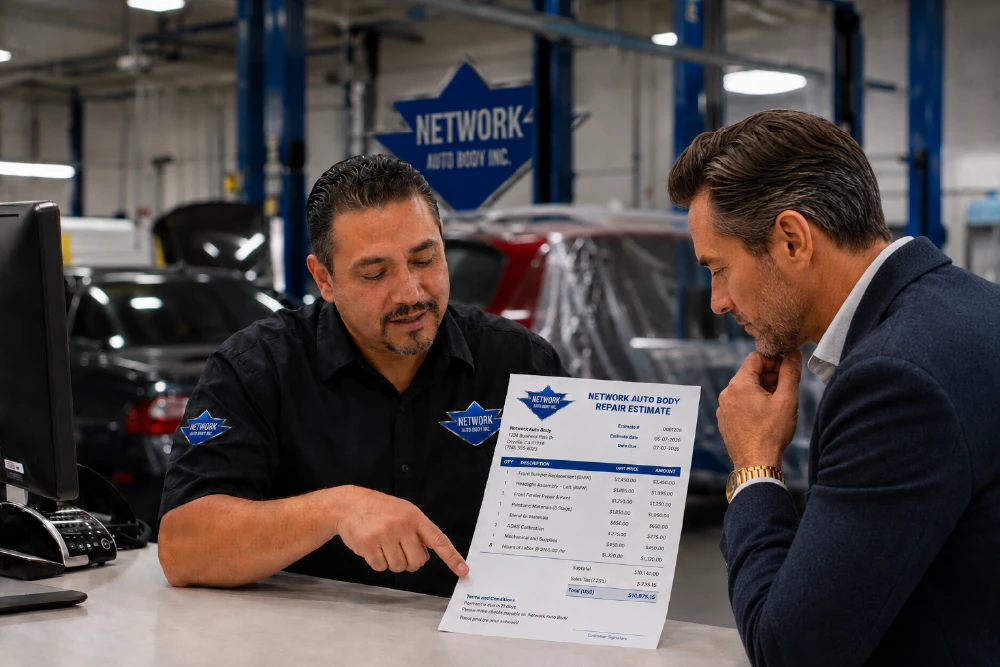
An auto body repair estimate is an itemized repair plan. It shows what the shop can see, what needs to be repaired or replaced, what labor may be required, what paint and refinish work may be needed, and what additional notes or approvals may apply.
The estimated total is one important part of the estimate, while the line items tell the full story.
A good estimate may include body labor, paint labor, refinish materials, replacement parts, diagnostic scans, calibration-related items, taxes, fees, notes, and possible supplement language. Some of these items may take a moment to understand, especially if you are comparing a body shop estimate with an insurance estimate.
For Los Angeles-area drivers, understanding the estimate helps you ask better questions before repairs begin. Network Auto Body’s 41-year local history, dealer-driven repair approach, foreign and domestic manufacturer capability, and Lifetime Warranty on qualifying repairs make estimate clarity especially important: the repair record should explain both what is being repaired and why it matters.
1. What an Auto Body Repair Estimate Includes
An auto body repair estimate is a written breakdown of the work a vehicle may need after an accident. It provides more than a price tag: it is a repair plan based on the information available at the time the estimate is written.
That phrase matters: available at the time.
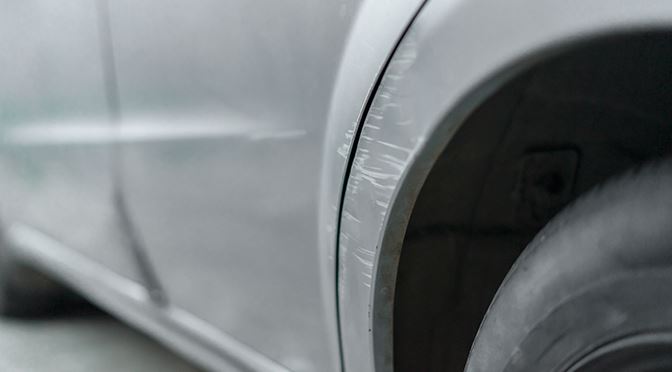
An estimate written from photos may reflect visible damage. An estimate written after an in-person inspection may include more detail. An estimate written after teardown or disassembly may include hidden damage as it becomes confirmable.
Network Auto Body’s live Online Estimates page explains this clearly: online estimates provide a useful quick estimate, while disassembly and deeper examination may reveal additional damage and add more detail.
So when you read an estimate, the total is one useful starting point. An even better question is:
“What information was this estimate based on?”
Was it based on photos? A quick walkaround? A detailed inspection? Teardown? Insurance review? The answer affects how complete the estimate may be.
An Estimate Is a Planning Document
A repair estimate usually shows:
- Vehicle information
- Customer or claim information
- Visible damage areas
- Labor operations
- Parts to repair or replace
- Paint and refinish work
- Materials
- Diagnostic or calibration-related items
- Notes, exclusions, or assumptions
- Taxes, fees, deductibles, or totals
The purpose is to organize the repair scope. It helps the customer, shop, and insurer understand what work is being considered.
How an Estimate Develops Into the Final Invoice
The final invoice may differ from the first estimate if the repair scope changes. That can happen when the shop finds hidden damage, receives insurer feedback, orders parts, completes disassembly, or updates the repair plan with a supplement.
This is normal in collision repair.
A first estimate often starts the repair conversation. A supplement or revised estimate may complete the picture after more information is available.
For customers, this is why understanding the line items is so useful. When a repair plan changes, you can better understand what changed and why.
2. The Main Sections of an Auto Body Repair Estimate
Every estimate may look slightly different depending on the software, insurance company, shop, and repair type. But most auto body estimates include similar sections.
Once you know what each section is trying to show, the document becomes much easier to read.
Customer, Vehicle, and Claim Information
At the top of the estimate, you may see basic information such as:
- Customer name
- Vehicle year, make, model, and trim
- VIN
- Mileage
- License plate
- Claim number, if insurance is involved
- Insurance company, if applicable
- Estimate date
- Shop or estimator information
This section matters because the repair plan depends on the exact vehicle. A 2020 model and a 2024 model may have different parts, sensors, materials, and repair procedures. Trim level can also affect bumpers, lighting, cameras, radar, parking sensors, and body components.
For a dealer-driven, manufacturer-aligned shop, correct vehicle identification supports both administration and repair planning. It helps the repair team connect the estimate to the correct parts, procedures, and repair documentation.
Damage Area or Estimate Sections
Next, the estimate may be organized by vehicle area. For example:
- Front bumper
- Rear bumper
- Left front door
- Right quarter panel
- Hood
- Fender
- Liftgate
- Roof
- Frame or unibody
- Paint/refinish section
This helps group related repair operations. If your vehicle was hit in the rear, the estimate may include rear bumper, liftgate, rear body panel, trunk trim, lamps, sensors, and refinish sections.
A customer can confirm that the estimate matches the accident area. If the vehicle was hit on the left rear and the estimate shows a bumper cover, it may be helpful to ask whether the shop has inspected related brackets, lamps, trim, and hidden areas.
Labor Categories
Labor is usually separated into categories because different work requires different skills, tools, procedures, and labor rates.
Common labor categories include:
- Body labor
- Paint labor
- Frame or structural labor
- Mechanical labor
- Electrical or diagnostic labor
- Refinish labor
- Sublet operations, when work is performed by a qualified outside vendor or specialist
Each repair includes the labor categories that fit its scope. A simple cosmetic repair may include body and paint labor. A more complex collision may include structural measuring, mechanical review, diagnostics, or calibration-related line items.
Parts Section
The parts section lists items that may need repair, replacement, removal, installation, or transfer.
Parts may include:
- Bumper covers
- Brackets
- Clips and retainers
- Lamps
- Fenders
- Doors
- Sensors
- Grilles
- Reinforcement parts
- Wheel liners
- Trim pieces
- Moldings
- OEM, aftermarket, recycled, or reconditioned parts
This section is one of the most important areas to read carefully because part type can affect fit, availability, cost, and repair planning. Network Auto Body’s ability to work across foreign and domestic manufacturers is relevant here: different makes and models may require different parts research and repair planning.
Paint, Materials, and Refinish Section
Paint and refinish work often appears separately from body labor because repairing a dent and refinishing the surface are different operations.
This section may include:
- Paint labor
- Clear coat
- Primer
- Blending into adjacent panels
- Color matching
- Paint materials
- Masking and prep
- Corrosion protection, when applicable
This section deserves careful attention because paint work can look simple from the outside. In reality, a quality refinish can involve preparation, color matching, blending, clear coat application, curing, and finish work.
Totals, Taxes, and Notes
Near the bottom, you may see totals for parts, labor, paint materials, sublet work, taxes, fees, deductible, and grand total.
The notes section may include assumptions, repair conditions, supplement language, parts disclaimers, or insurer-related information.
Review this section carefully. Notes can explain whether the estimate is preliminary, whether hidden damage may change the scope, or whether certain repairs depend on approval or inspection.
3. How to Read Labor Line Items
Labor line items show the work the repair team expects to perform. They are usually listed with an operation, a labor category, and a number of hours.
This part of an auto body repair estimate becomes easier to understand when labor hours are viewed as structured repair operations.
Customers sometimes read “labor hours” as if it only means the exact amount of time a technician will stand beside the vehicle with a tool in hand. In reality, labor time on an estimate is a structured way to represent repair operations. It may reflect industry estimating systems, repair complexity, access, removal and installation, setup time, refinish steps, or procedure-based work.
Common Labor Categories Explained
| Labor Category | What It Usually Means |
| Body labor | Repairing or replacing damaged body panels, bumpers, brackets, trim, or related parts |
| Paint labor | Preparing and refinishing painted surfaces |
| Frame / structural labor | Measuring, pulling, aligning, or repairing structural or unibody components |
| Mechanical labor | Work involving mechanical components affected by the collision |
| Electrical / diagnostic labor | Scans, wiring checks, sensor-related diagnosis, or electronic-system review |
| Refinish labor | Paint-related operations such as blending, clear coat, masking, and refinishing |
| Sublet labor | Work performed by an outside specialist or vendor, when required |
Each estimate includes the labor types that reflect the repair scope.
For example, a bumper scrape may include body and paint labor. A front-end collision may include body, paint, mechanical, diagnostics, and possibly structural labor depending on the damage.
R&I, R&R, Repair, and Replace
Auto body estimates often use abbreviations. These may vary by estimating platform, but several common terms appear frequently.
| Term | Plain-Language Meaning |
| R&I | Remove and install. A part is removed and put back on, often to access nearby damage or complete paint work. |
| R&R | Remove and replace. A damaged part is removed and replaced with another part. |
| Repair | The existing part is fixed rather than replaced. |
| Replace | The damaged part is replaced instead of repaired. |
| Refinish | The part is painted or refinished. |
| Blend | Paint is blended into an adjacent panel for a better color transition. |
| Overhaul | A component is taken apart and reassembled, often used with bumper assemblies or doors. |
These terms help explain the repair approach.
For example, if a door handle is listed as R&I, the handle may simply need to be removed so the door can be refinished properly. If a bumper cover is listed as R&R, that means the damaged cover is being replaced.
Why Labor Line Items May Look Duplicated
Sometimes an estimate appears to list similar work more than once. A closer review can clarify how each operation supports the repair.
For example, you may see a bumper operation, a refinish operation, and a remove/install operation related to the same area. These entries may represent different tasks listed separately.
A bumper repair may involve:
- Removing the bumper cover
- Repairing or replacing the bumper cover
- Transferring sensors or trim
- Refinishing the bumper cover
- Reinstalling the bumper cover
- Checking fitment
Those are different operations tied to one damaged area.
Why Labor Clarity Matters
Labor line items help show the difference between a surface repair and a complete repair plan.
If the estimate focuses on a visible panel repair, it may be worth asking whether related removal, refinish, or inspection steps will appear in a later stage. If the estimate includes diagnostic or structural labor, ask what damage or symptoms support that line.
For Network Auto Body customers, the goal is transparency. A repair estimate should explain the work clearly in plain language. That kind of clear documentation supports the company’s 41-year local reputation and its commitment to repair planning across foreign and domestic vehicles.
4. Parts Line Items: OEM, Aftermarket, Recycled, and Reconditioned Parts
The parts section of an auto body repair estimate can be one of the most important sections to review. It tells you which parts may be repaired, replaced, removed, transferred, or inspected.
It can also show what type of replacement part is being considered.
This matters because parts can be listed in several ways. Depending on the vehicle, repair plan, insurance review, availability, manufacturer requirements, and damage type, an estimate may include different part categories.
| Part Type | What It Usually Means |
| OEM | Original Equipment Manufacturer part made by or for the vehicle manufacturer |
| Aftermarket | A new part made by a company other than the vehicle manufacturer |
| Recycled / LKQ | A used original part sourced from another vehicle |
| Reconditioned | A used or previously damaged part that has been restored for reuse |
| Remanufactured | A part rebuilt to meet certain functional standards, often used more with mechanical or electronic components |
A basic understanding of the part type can help every customer review the estimate.
For example, if the estimate lists a bumper cover, headlight, sensor bracket, fender, or door shell, the part type can affect availability, fit, cost, and repair planning. It may also affect what questions you should ask before approving the repair.
Why Part Type Can Matter
Part type may matter for several reasons:
- Fit and finish
- Manufacturer repair procedures
- Availability and delivery timing
- Insurance estimate requirements
- Sensor or bracket compatibility
- Paint and refinish preparation
- Warranty-backed workmanship documentation
This is especially important for modern vehicles. A bumper cover may look simple, but it may hold parking sensors, radar brackets, trim pieces, grilles, clips, absorbers, and mounting points. A light assembly may involve electronics, aiming, seals, or tabs. A door may include wiring, glass, trim, handles, moldings, and side-impact components.
Network Auto Body’s onboarding information emphasizes service capability across foreign and domestic manufacturers. That matters because different makes and models may require different research, part sourcing, and repair planning. A careful estimate should account for the vehicle’s specific design instead of treating every car the same way.
Repair vs. Replace
A parts line may also show whether a part is being repaired or replaced.
A repair operation means the existing part is being restored, reshaped, refinished, or corrected. A replace operation means the damaged part is being removed and a replacement part is being installed.
The best option for each repair depends on the part, the damage, manufacturer guidance, safety considerations, repair access, and cost-effectiveness.
For example:
- A small dent in a door skin may be repairable.
- A cracked bumper cover may need replacement when replacement is the practical repair method.
- A broken bracket may need replacement because it affects fitment.
- A damaged reinforcement may require closer inspection or replacement.
- A sensor bracket may need attention because sensor positioning can matter.
A good estimate should make the repair method clear enough that you understand what the shop is planning.
Transfer, Overhaul, and Related Parts
Some line items describe removal, transfer, or reinstallation steps for parts that support the repair.
For example, if a bumper cover is replaced, items such as sensors, trim, reflectors, grilles, clips, or brackets may need to be transferred to the new bumper cover. If a door shell is replaced, glass, handles, moldings, wiring, and interior trim may need to be transferred.
These steps can make some line items feel less familiar at first.
A customer may wonder, “Why is my estimate mentioning a part that looks intact?” The part may need to be removed or transferred so the repair can be completed properly.
Questions to Ask About Parts
For clarity about a part line item, ask:
- Is this part being repaired or replaced?
- What type of replacement part is listed?
- Is the part visible, hidden, or related to another damaged area?
- Does this part affect fit, function, sensors, or safety systems?
- Is this part required for manufacturer-aligned repair planning?
- Could the part type change after teardown or insurance review?
Clear parts documentation helps customers understand the estimate before the vehicle moves deeper into repair.
5. Paint, Refinish, Materials, and Blending Explained
Paint and refinish line items may feel less familiar because replacement parts are often easier to recognize.
If a bumper cover is cracked, a customer can see the part. If a door is dented, the damage is visible. But paint, blending, prep work, clear coat, and materials can feel less tangible on the estimate.
They remain equally important.
Paint and refinish work can affect how the finished repair looks, how well the color transition works, and how the repaired area blends with the rest of the vehicle.
What “Refinish” Means
Refinish usually means the process of preparing and painting a repaired or replaced surface.
A refinish line item may include work such as:
- Surface preparation
- Sanding
- Masking
- Primer
- Sealer, when applicable
- Base coat
- Clear coat
- Color matching
- Blending
- Buffing or finish work, when applicable
A customer may see a line for body labor and another line for refinish labor on the same panel. These lines usually represent two separate operations. Body labor repairs the shape or structure of the part. Refinish labor restores the painted surface.
For example, a door may need body labor to repair the dent and refinish labor to repaint the repaired area.
Why Paint Materials Appear Separately
Paint materials may appear as a separate charge or category because refinish work uses consumable materials.
- Primer
- Base coat
- Clear coat
- Sandpaper
- Masking materials
- Tape
- Mixing materials
- Solvents or cleaners
- Other refinish supplies
Paint materials are a standard part of the repair operation, and the way they are calculated can vary by estimating the system, shop, repair type, and insurer.
What Blending Means
Blending is a paint process used to help the repaired or replaced panel transition more naturally into nearby panels.
A vehicle’s paint color can change over time because of sun exposure, age, wear, factory variation, and previous repairs. Even when the paint code is known, blending may help a freshly refinished panel match the surrounding finish.
Blending helps soften that transition.
For example, if a front fender is replaced, the estimate may include blending into the front door. If a quarter panel repair is performed, the nearby door or bumper area may need refinish planning depending on the repair.
A customer may ask, “Why is my estimate showing paint work on an adjacent panel?”
The answer may be blending. The adjacent panel may receive paint work to help the repaired area match visually.
Why Color Matching Takes Skill
Color matching often involves more than using a paint code. Modern vehicle colors can include metallic, pearl, tri-coat, matte, tinted clear, and special-effect finishes. Lighting, viewing angle, and panel shape can affect how the color looks.
This is why refinish planning matters. A repair with a smooth color transition feels complete to the customer.
For Network Auto Body, paint and refinish line items are part of the repair plan. They help restore the appearance of the vehicle after the physical repair work is complete.
How Paint and Refinish Connect to Lifetime Warranty
Network Auto Body’s live warranty page states that workmanship-related unibody, body, and refinish work is covered under its Lifetime Warranty for as long as the customer owns the vehicle, subject to stated exclusions and conditions.
That makes clear documentation important.
When refinish line items are included, they help show what was painted, blended, repaired, or refinished. For qualifying repairs, that repair record can support the integrity of warranty-backed workmanship.
A customer can ask for clarification about paint or blend lines. The goal is to understand why the necessary refinish work is listed.
6. Diagnostics, Scans, Calibrations, and Modern Vehicle Systems
Modern collision repair estimates may include diagnostic or calibration-related line items. These may feel unfamiliar because they reflect modern vehicle technology alongside traditional body repair.
Today’s vehicles combine metal, plastic, and paint with cameras, radar, sensors, wiring, electronic modules, advanced driver assistance systems, airbag-related components, and manufacturer-specific repair procedures.
This is why some estimates include scans, diagnostics, or calibration-related notes.
What Diagnostic Scans Can Show
A diagnostic scan can help identify electronic trouble codes or system concerns that may be related to the accident. It may also help the repair team understand whether systems need additional review before or after repair.
A scan is a tool for gathering information and can provide clarity about a vehicle system’s condition.
Depending on the vehicle and damage, diagnostic-related line items may be connected to:
- Parking sensors
- Blind spot systems
- Forward-facing cameras
- Radar units
- Airbag or restraint systems
- Lighting systems
- Wiring harnesses
- Electronic modules
- Warning lights
- Battery or electrical concerns
Each repair uses the diagnostic process appropriate for the vehicle and damage. The estimate should connect the line item to the vehicle, the damage area, and the repair requirements.
What Calibration Means
Calibration is the process of setting or verifying certain vehicle systems so they operate according to required parameters. This may be relevant when a collision affects sensors, cameras, radar units, or related mounting locations.
Examples may include systems connected to:
- Lane assistance
- Adaptive cruise control
- Parking assistance
- Blind spot monitoring
- Forward collision warning
- Camera or radar positioning
Calibration applies when the vehicle, equipment, damage area, repair procedures, and system design call for it.
Why Manufacturer-Aligned Repair Planning Matters
Because Network Auto Body operates with a dealer-driven and manufacturer-aligned model, diagnostic and calibration-related line items should be understood in the context of modern repair planning.
The onboarding workbook also emphasizes coverage across foreign and domestic manufacturers. This is important because repair procedures, sensor placement, parts, and inspection requirements can vary widely by make and model.
A practical way to explain this to customers is:
Because Network Auto Body is equipped to handle foreign and domestic manufacturers, the estimate process may account for vehicle-specific inspection needs, repair documentation, diagnostic steps, and manufacturer-aligned procedures when they apply.
Each estimate should reflect the vehicle’s actual technology and damage, including advanced diagnostics when appropriate.
Why These Line Items Deserve Attention
Customers sometimes focus only on visible body damage and wonder why scans or calibration-related items appear on the estimate. But if the impact occurred near sensors, cameras, radar, lights, bumpers, mirrors, or structural areas, electronic systems may need attention.
Reviewing these line items early creates clarity throughout the repair.
A repair can look good cosmetically but still require documentation or review for systems affected by the accident. That is why modern estimates may include more than parts and paint.
Questions to Ask About Diagnostics
If you see diagnostics or calibration-related items on your estimate, ask:
- What system is being checked?
- Is this related to the accident area?
- Is the item required by the vehicle manufacturer’s procedure?
- Is it a pre-repair scan, post-repair scan, or calibration-related step?
- Will this be documented in the repair record?
- Does this affect timing or final repair verification?
Clear answers help customers understand why the estimate includes modern repair operations that may be located beneath exterior parts.
7. Supplements and Why Estimates Can Change
An auto body repair estimate can change as new information becomes available.
This is where a supplement comes in.
A supplement is an update to the original estimate. It may add newly discovered parts, labor, paint, refinish work, diagnostics, calibration-related steps, or repair procedures that became visible or confirmable during deeper inspection.
For example, the first estimate may list visible bumper damage. After the bumper cover is removed, the shop may find damaged reinforcement, broken brackets, sensor mounting issues, or wiring concerns. Those added findings may need to be documented in a supplement.
Why Supplements Happen
Supplements usually happen because collision damage can be hidden.
A first estimate may be based on:
- Photos
- A visual inspection
- An insurance inspection
- A customer description
- Visible exterior damage
- Initial repair planning
Some damage becomes confirmable after the vehicle is disassembled.
Hidden damage may include:
- Bent reinforcement parts
- Broken mounting brackets
- Cracked tabs or retainers
- Wiring damage
- Sensor or camera mounting issues
- Structural or unibody concerns
- Additional paint or blending needs
- Parts revealed during deeper inspection
A supplement helps update the estimate so the repair plan reflects what the vehicle actually needs.
A Supplement Should Be Documented Clearly
A clear supplement explains what changed and why.
A clear supplement should show:
- What new damage was found
- Where the damage is located
- Whether photos or notes support the change
- What labor, parts, or materials were added
- Whether insurer review is needed
- Whether timing may be affected
- How the added item fits into the repair plan
For customers, this is where estimated literacy matters. If you understand the original line items, it becomes much easier to understand what changed in the supplement.
Supplements and Insurance Review
If insurance is involved, the supplement may be submitted to the insurer or adjuster for review. Each supplement follows the insurer’s review process, which can depend on the claim, policy, documentation, and repair plan.
A body shop can document what it found. The insurer may still need to review the added items.
Good communication is important here. Ask whether the supplement has been submitted, whether approval is pending, and whether any approved repair work can continue while the supplement is being reviewed.
Why Supplements Protect the Repair Record
Supplements cover both cost and repair-record protection.
Documenting hidden damage helps the final repair record show the full scope of what the vehicle needed and maintains clarity around parts, paint, structure, diagnostics, and warranty-backed workmanship.
For Network Auto Body customers across Los Angeles, a clear supplement process supports transparency. It also aligns with the company’s Lifetime Warranty positioning on qualifying workmanship-related repairs because a complete repair record helps show what work was performed and why it mattered.
8. Taxes, Fees, Deductibles, and Final Invoice Differences
After reviewing labor, parts, paint, diagnostics, and supplements, customers often jump to the bottom of the estimate. That is understandable. The total matters.
But the final section of an estimate can include several items that are easy to overlook.
These may include taxes, fees, deductibles, sublet charges, materials, and notes about what is included or excluded. Understanding this section creates greater clarity throughout the process.
Taxes and Fees
Taxes and fees can vary depending on the parts, materials, local requirements, and estimate structure. They may appear near the bottom of the estimate rather than beside each individual line item.
Customers should look for whether the estimate separates:
- Parts total
- Labor total
- Paint materials
- Sublet work
- Taxes
- Fees
- Grand total
Ask the shop to explain how the total is calculated whenever more detail would be helpful.
Deductible
If an insurance claim is involved, the estimate may show a deductible. The deductible is the portion the customer may be responsible for under the policy before insurance payment applies.
A deductible comes from the insurance policy and represents the customer’s portion, separate from body shop repair charges.
Confirm your deductible with your insurer and ask the shop how it appears on the repair paperwork.
Sublet Work
Some estimates include sublet line items. Sublet means a specific operation may be performed by a qualified outside vendor or specialist.
This can happen with certain mechanical work, glass, alignments, calibrations, specialty diagnostics, or other procedures depending on the repair.
A sublet line item identifies work performed by a qualified outside specialist and should be explained clearly.
Ask:
- What work is being sublet?
- Why is it needed?
- Who performs it?
- Is it related to the accident damage?
- Will it be documented in the final repair record?
Final Invoice Differences
The final invoice may differ from the first estimate as the repair scope develops.
This can happen because of:
- Hidden damage found after teardown
- Supplement approval
- Parts changes
- Labor changes
- Paint or blending updates
- Diagnostic findings
- Additional insurer review
- Repair-plan changes after deeper inspection
The key is documentation. If the final invoice differs from the original estimate, the customer should be able to see why.
A professional estimate process should create a clear trail from the first estimate to any supplement and then to the final repair record.
9. Questions to Ask Before Approving the Estimate
You can make an informed decision by understanding the main sections and asking questions.
A clear body shop estimate should help you understand the repair plan in plain language. When a line item needs more context, ask about it before approving the work.
“What Information Was This Estimate Based On?”
This helps you understand whether the estimate came from photos, an in-person inspection, insurer review, or teardown. A photo-based estimate provides a useful starting point and captures visible damage. An in-person estimate may be more detailed. A teardown-based estimate may be more complete.
“Which Parts Are Being Repaired, and Which Are Being Replaced?”
This helps you understand the repair method. Ask whether a damaged part is being repaired, replaced, removed and reinstalled, or transferred. If replacement parts are listed, ask what type of parts are being used and whether that could change after review or availability checks.
“What Do the Labor Hours Represent?”
Labor hours can include different operations beyond visible hands-on repair time. Ask which labor categories are included and why. Body labor may repair or replace damaged panels. Paint labor may refinish the repaired surface. Diagnostic labor may review electronic systems. Structural labor may relate to measuring or unibody work.
“Why Is Paint or Blending Listed on an Adjacent Panel?”
This is one of the most common questions customers ask. If an adjacent panel appears on the estimate, it may be there for blending. Blending can help the repaired area transition more naturally into the surrounding paint. The panel can be part of the refinish plan even when the impact occurred elsewhere.
“Are Diagnostic Scans or Calibration-Related Steps Needed?”
If the damage is near sensors, cameras, radar, lights, bumpers, mirrors, or structural areas, diagnostics may be part of the repair planning. Ask what system is being reviewed and why it relates to the accident.
“Could This Estimate Change Later?”
This is an important question. Ask whether hidden damage is possible, whether teardown is needed, and whether a supplement may be submitted later. A transparent answer may explain that based on what is visible now, this is the current plan, and any hidden damage will be documented and explained before moving forward.
“How Does This Estimate Connect to the Warranty-Backed Repair Record?”
For qualifying repairs at Network Auto Body, documentation matters because the company offers a Lifetime Warranty on workmanship-related unibody, body, and refinish work, subject to stated terms and exclusions. Ask how the repair record will show the work performed, especially for body, unibody, and refinish operations.
10. Why Estimate Clarity Matters Across Los Angeles
Reading an auto body repair estimate line by line helps you understand your repair plan well enough to make informed decisions.
After an accident, customers may be managing insurance, transportation, rental timing, repair scheduling, and questions about the vehicle. A clear estimate helps make the process feel more manageable.
For drivers across Los Angeles, estimate clarity is especially important because the repair process may involve more than visible damage.
A proper estimate may need to account for:
- Foreign and domestic manufacturer requirements
- Dealer-driven repair documentation
- Parts type and availability
- Hidden damage
- Paint and refinish planning
- Diagnostic scans
- Calibration-related steps
- Supplements
- Warranty-backed workmanship documentation
Network Auto Body’s 41-year local history gives customers a reason to expect plain-language communication. The goal is to explain what each major section means and why it is part of the repair plan, helping the customer review the total with confidence.
A clear estimate also helps support the final repair record. If hidden damage is found, if a supplement is needed, or if refinish work must be documented, the customer can follow the story from original estimate to completed repair.
That level of transparency matters.
Conclusion: A Repair Estimate Is More Than the Total at the Bottom
An auto body repair estimate may look detailed at first. It may include labor categories, abbreviations, parts types, paint materials, diagnostics, taxes, fees, deductibles, notes, and possible supplement language.
But once you know how to read the major sections, the estimate becomes much easier to understand.
Start with the basics:
- What information was the estimate based on?
- What parts are being repaired or replaced?
- What labor categories are listed?
- What paint and refinish work is included?
- Are diagnostics or calibration-related steps needed?
- Could hidden damage change the estimate later?
- How will the final repair record be documented?
The total matters, but the line items explain the repair plan.
If you are in Los Angeles, Network Auto Body can help you review your estimate, understand the repair scope, and choose the right next step.
| CTA Block: Get a Clear Estimate Review in Los Angeles Clear estimate language helps you move forward with confidence about your vehicle’s repair. For more than 41 years, Network Auto Body has helped Los Angeles-area drivers understand collision damage, repair planning, parts, paint, diagnostics, and supplements in plain language. Backed by a Lifetime Warranty on qualifying repairs and a dealer-driven, manufacturer-aligned repair approach for foreign and domestic vehicles, our team helps make your estimate easier to understand before repairs move forward. Schedule your estimate review or in-person inspection at your nearest Network Auto Body location in Valencia, Downtown L.A., North Hollywood, Van Nuys, or Oxnard today. |
FAQ Section
1. How do I read an auto body repair estimate?
Start by reviewing the vehicle information, damage area, labor categories, parts list, paint/refinish section, diagnostic items, notes, taxes, fees, and final total. The estimate should show what the repair plan includes and what may still require inspection or approval.
2. What do labor hours mean on a collision repair estimate?
Labor hours represent the estimated repair operations needed for the job. They may include body labor, paint labor, mechanical work, structural labor, diagnostics, or refinish operations depending on the damage.
3. What does R&I mean on an auto body estimate?
R&I means remove and install. It usually means a part must be removed and put back on to access damage, complete paint work, or perform another repair operation. It can apply whether the part itself is damaged or simply needs to be moved for access.
4. What does R&R mean on a body shop estimate?
R&R means remove and replace. It means the damaged part is being removed and replaced with another part rather than repaired.
5. Why does my estimate include paint or blending on an adjacent panel?
That may be for color blending. A nearby panel may need refinish work so the repaired panel transitions more naturally into the surrounding paint, especially with metallic, pearl, aged, or special-effect finishes.
6. What is a supplement on an auto body repair estimate?
A supplement is an update to the original estimate. It may add hidden damage, additional parts, labor, paint, diagnostics, or other repair needs discovered after inspection or disassembly.
7. Why is the body shop estimate different from the insurance estimate?
Differences can happen because one estimate may be based on photos or visible damage only, while another may include deeper inspection, hidden damage, manufacturer procedures, parts research, paint needs, or supplemental documentation.
8. Does the first repair estimate show the final cost?
The first estimate may be preliminary when hidden damage is possible. The final repair cost may develop after teardown, supplement review, parts updates, or additional repair documentation.
9. What should I ask before approving an auto body repair estimate?
Ask what the estimate was based on, which parts are being repaired or replaced, what labor hours represent, why paint or blending is listed, whether diagnostics are needed, whether the estimate could change, and how the final repair record will be documented.